Buky Schwartz
Israeli sculptor and video artist (1932–2009), one of the early pioneers of video art. From the mid-1970s he made closed-circuit videoconstructions of two kinds: objects the viewer walks around, and environments the viewer stands inside. His work was shown at the Venice Biennale (1966), the Whitney Biennial (1981), the Carnegie International (1982) and Documenta 8 (1987).
In public collections
Whitney Museum of American Art · Solomon R. Guggenheim Museum · Smithsonian American Art Museum · ZKM Karlsruhe · Carnegie Museum of Art · Hara Museum, Tokyo
Selected works
 Videoconstructions, 1978
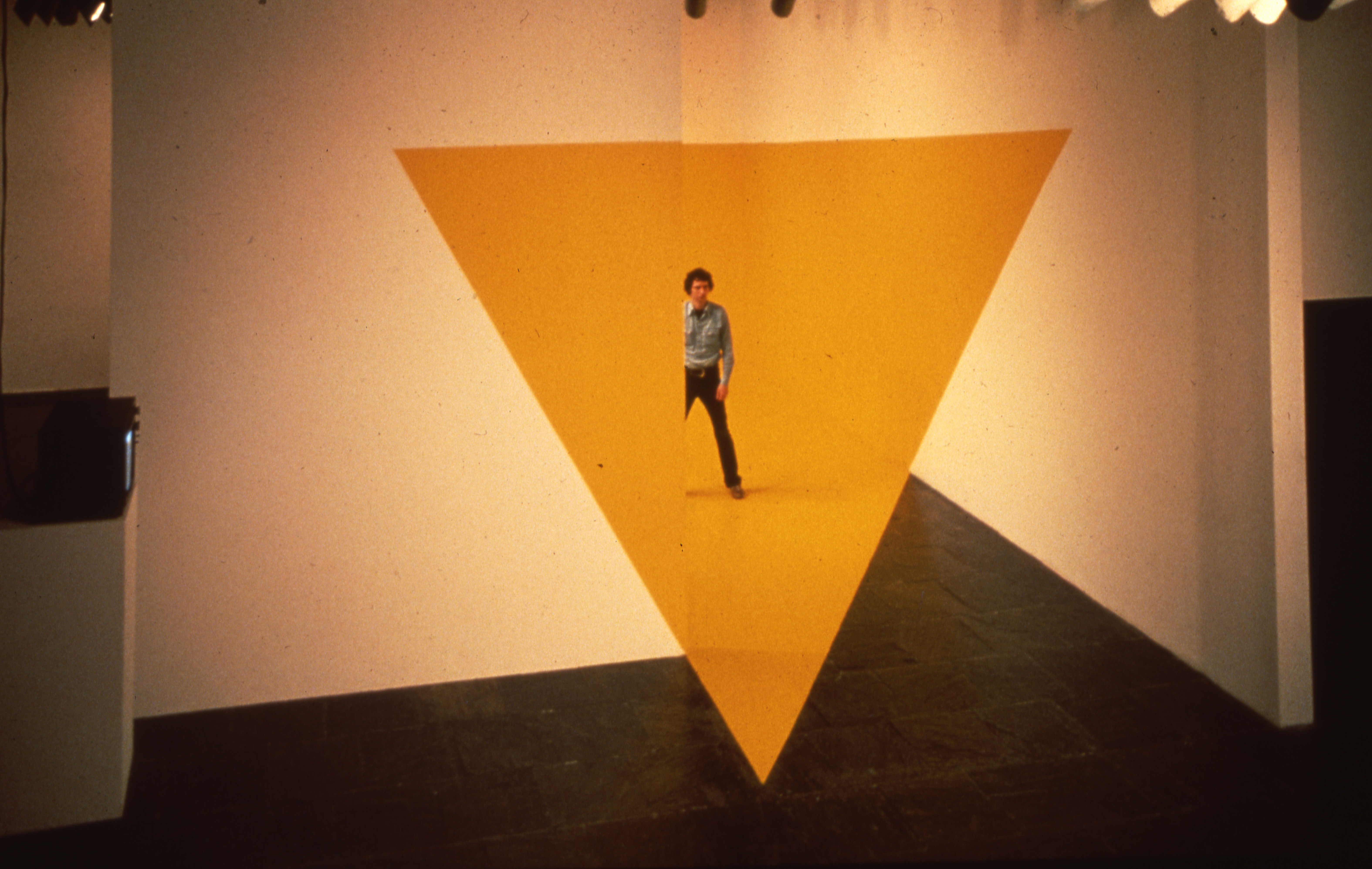
- Yellow Triangle, 1979
 Box #1, 1978
 Painted Projections, 1977
 The Circle, 1978
 The Chair, 1980
 Video See-Saw, 1988
 Trojan Horse, 1988
 TV Stripes, 1985
In his own words
Buky Schwartz — a short documentary, New York City, 2007 (videoart.net, Bryce Wolkowitz Gallery).
Biography
Born in Jerusalem and originally trained as a sculptor in Israel, Schwartz moved to London in 1959, where he played an important role in the hotbed of new sculptural directions at St. Martin’s School of Art during the 1960s. In 1971 Schwartz moved to New York, where he continued to reside part of each year.